Showing posts with label machin. Show all posts

Wednesday, June 19, 2024

War is a tragedy but can sometimes throw up unexpected postal history

If you tried to send a letter from the UK to Palestine at the present time you would find it rejected at the PO counter (I hope) or returned if you dropped it into a postbox as the service is currently suspended.  

Likewise mail to Israel experiences delays due to disrupted flights.  Mail to both Russia and Ukraine is still being despatched but is subject to delay, while there has been no service to Crimea or the Donbass regions since 2014.

On the other hand, the United States Postal Service suspended sendings to both Russia and Belarus in March 2022.  

SH has sent pictures of a cover shared with him by a Postcrosser.  The letter was addressed from the UK to Belarus but mis-sorted to the United States.  Normally such mis-sorts would simply be re-routed to the correct destination.  But in this case there is no US-Belarus service, so the item was returned to sender, suitably endorsed.  

A great item to add to a collection of postal history of the UK, US or Belarus, Russia or Ukraine!

UK - Belarus letter mid-2024 returned to sender after mis-sorting to the USA. Yellow USPS 'Unable to Forward' label.

USPS's fuller explanation of suspension and advice to claim refund of postage paid.

This is the first item I have seen of this sort.  I shall post it on a couple of stamp forums to find out if there are any others - there should be from the USA, but not so many from the UK!


Monday, April 6, 2020

Huge Special Delivery cover and small printed papers

As part of my de-cluttering exercise in Norvic Towers I've been emptying the attic.  Not the best place to store stamps or postal history, and of course I don't.  Which doesn't mean that I don't find things there!


Special Delivery.
 
When my wife and I received this stamps were the last thing on my mind - it contained a card for our wedding!   At that time I still thought postal history was something that the grey-haired old men exhibited at major shows and won medals for.  I collected stamps, but although I liked my Saudi Arabia and Scandinavian stamps on cover those are other stories, and I wasn't too concerned about GB.  So it was put away with a lot of other cards etc and memorabilia from the time.


From early September 1976 this is prepaid at 78½p for the inland Special Delivery rate. 


According to the very excellent GBPS website the SD fee was 60p from 29 September 1975 to 19 August 1979.  Postage is 18½p which represents the 4th step, or 151-200g First Class from 7 June 1976 to 12 June 1977.

Only when you see the whole thing, do you appreciate that the weight - for a massive greetings card in cardboard sleeve - was probably correct:


It's approximately 20 x 14 inches (520 x 370mm).  It's fair to say that my late aunt and uncle were quite extravagant and making a point.

You will notice that I have taken a liberty with the Special Delivery label!  The cover was badly foxed, damaged, and far too big to store or show sensibly, so I cut it down.  We know it was posted from Essex to Somerset, and even though one of the 20p stamps is damaged, it is still a good piece to have.


OHMS Newspaper Wrappers

The second half of today's post is illustrated by two newspaper wrappers sent (one at least in 1968) from Edinburgh to Germany, both paying the lowest (2 ounce) printed paper reduced rate of 2d.

My thanks to MC for allowing me to show these gems - I'm really quite envious of a 2d rate, and of the ½d block used on their own.

One is stamped with a 2d Machin definitive and the other with a block of 4 x ½d Machins.


What is especially interesting for me is the original source of these. Although attributed by the return address to the Registrar-General in Edinburgh, the wrappers - sent to the Federal German Ministry of Health - originated at Her Majesty's Stationery Office printing works in Annandale Street, Edinburgh - the site has since been redeveloped.

I can tell this by the H M / S O perfins - perforated initials in the stamps:


Under the 2d stamp is the Official Paid mark, which wasn't valid for sending outside the UK, so stamps were used.  Two copies of (I suppose) a Bulletin from the Registrar, were sent in each wrapper.  (2 CPS - CPS may well refer to the title but I don't know what it is.).

The HMSO in-house perfin machine was set up long before the Machins were issued - at least as early as 1949.  The machine possibly had two settings; one was for small definitives - sheets of 12 columns across.  The other was for large definitives, possibly the Wilding Castles.   So on the decimal low value Machins - only 10 columns across - the sheet margins were also perforated.  But the high value Machins were also used, mainly on overseas parcels of books or other publications.  In this case the sheets were folded in half vertically along the gutter, so not only is the gutter perfinned, but the stamps on one side are perfinned normally, and on the other side they are reversed, which makes an interesting pair.


Although I did have some of these I have passed them on to somebody who will appreciated them more - although I have kept a couple of covers.

If you collect perfins, you can still find these occasionally in dealers' 'back of the book' stock, and look out also for their predecessors from 1922-1949. This design mimicked the watermark widely used in security printing, and also appeared on many of the stationery and office equipment items, such as rulers.  Unfortunately the authorities pointed out that use of the Crown on the stamps was not permitted, so the design was changed.  


The Board of Trade also fell foul of this ruling but that department didn't use any alternative.

Tuesday, March 26, 2019

Common stamps - but what were they used for?

The first set of Machin definitives included an 8d in red (or bright vermillion) issued on 1 July 1968. This was just one of the range from ½d to 1/9d replacing the Wilding definitives started in 1952.

But with the 4d brown difficult to process, that value was changed to red, and the 8d to pale blue (light turquoise-blue) on 6 January 1969.  But was there a specific purpose to this value, both colours of which are not at all uncommon in either mint or used condition?

According to British Postal Rates 1937-2000 (Johnson & Peet) the uses at the time of issue of the 8d red were:

Inland Letter 4 - 6 ounces (until 15 September 1968)
Inland Printed Papers 8 to 10 ounces (until  5 January 1969)
Foreign Printed Papers Surface 8 to 10 ounces (to 31 August 1968)
Foreign Samples Surface 4 to 6 ounces (to 31 August 1968)
Foreign Newspaper airmail Group B destinations ½ to 1 ounce and 2nd class airmail group C up to ½ ounce (both to 5 January 1969)

The specific uses of the 8d pale blue all ran from 6 January 1969 to 14 February 1971:

Inland letter 2nd class 6 to 8 ounces, and printed papers 8 to 10 ounces
Foreign Surface Printed Papers 4 to 6 ounces and Samples 6 to 8 ounces
Foreign Airmail 2nd Newspapers Group B ½ to 1 ounce and 2nd class Group C up to ½ ounce.

So, how how easy is it to find any examples of these uses on full cover or wrapper today?  Well, I would suggest very difficult.  Newspaper wrappers are usually discarded, bulk printed paper envelopes or packaging are rarely 'attractive' (or small) enough for people to have collected in the past, and of course collectors in foreign destinations would (at that time) want the stamps for the collections.

So although the red had been replaced by the time of the use shown here, it is still scarce enough, and attractive enough to be worthy of including in a postal history usage collection.  These two Printed Paper usages from Norwich to Australia, the red on 26 February and the blue on 20 November 1969 sold fifty years later on eBay for AU$65.99 - £35.50 at present.

But I'm not actually certain what postage rate they were paying, given the above tables!

I apologise that the covers are not showing. I don't know why they were not embedded in blogger at the time but hosted on imgur.com, where my account was closed some years ago.


Another aspect of Postal History collecting is the inclusion of at least the name and address of the recipient (and maybe the sender), and sometimes content.  From these pictures we can establish the background of the addressee:
Austine Marshall

Another outstanding lady [amateur radio] operator was Austine Henry (nee Marshall), VK3YL, first licenced in 1930. In many ways, Austine had similarities with Florence. She constructed her own transmitters, for which she won prizes and was a keen operator who was deeply respected by other amateurs.

In 1934 Austine joined the R.A.A.F. Reserve and during WWII, went on to train many operators in Morse code at the WIA during WWII.
Postal History collectors - certainly the purchaser of this pair - should be grateful that Mrs Henry kept the envelopes in which, presumably, she received QSL cards (confirmation of radio contact from other radio amateurs.\

Wednesday, March 17, 2010

Premium services: registered post, special delivery, and recorded delivery

The fee for registration and special delivery was 3 shillings on top of the basic letter rate, but there was no 3s stamp.

Special Delivery 1967 - 4d brown and 2 x 1/6d Machins
Image

Registered 1970 - 5d blue and 2 x 1/6d Machins with a nice Burnham Market village registration label. Even now the permanent population is less than 1,000 although it is swelled all year round by visitors from London and has acquired the nick-name Chelsea-on-sea.
Image

Recorded Delivery. Registration cost a lot of money in 1960 and there was a need for a low-cost confirmation of delivery, without the insurance element. The recorded delivery service was introduced in 1961 with an initial fee of 6d. By 1967 the fee had been increased to 9d, still considerably less than the registration fee. Recorded Delivery could also be used with second class mail from the introduction of the 2-tier system in September 1968. The letters had to be posted over the counter, but no special handling was involved until delivery and ordinary machine postmarks were applied, rather than the counter stamps used for the higher-cost services.

4d Machin and 9d Wilding, 1s Wilding and 1d Machin, 1968 (By this time Machins had been issued for all the values shown here.)
Image
Image

1d and 1s Machins, 1969
Image

1st class rate 5d blue with 9d green Machin 1969
Image

Recorded Delivery (continued) - 1st class 5d rate and 9d Recorded Fee

- paid by 2d and 1s Machins 1969
Image

- paid by 4d centre band and 10d Machins 1968, a nice use of the 10d unfortunately on an oversize cover
Image

- paid by a pair of 7d Machins, 1968. Possibly my favourite colour of all for Machins
Image

Underpaid, surcharged - postage due

Underpaid mail was assumed to be posted at 2nd class rates and usually surcharged accordingly although sometimes, as now, it escaped detection.

Stamped with a 1d Machin, and therefore surcharged at (4d-1d) x 2 - with 6d postage due (1970) (although from the manuscript marking they obviously had to think twice about it!)
Image

Unpaid, surcharged 8d but not always with postage due stamps applied. (1967 & 1970) (The one with the dues is actually before the two-tier system)
Image
Image

Underpaid - 1d Machin treated as 2nd class, 2d Wilding treated as 1st class. (1st class mail had the time above the date, 2nd class has no time shown.) The 1d Machin might have been seen as a 4d brown, although the 4d red had been in use for over a year. Both these 1970.
Image
Image

Sunday, March 14, 2010

1968: Two-tier post introduced

On 16 September 1968, in an attempt to give them greater flexibility in moving the mail by holding some back for later processing, the Post Office introduced 'Two Tier Post'. First class post would have a target of next-day delivery, while 2nd class would be delivered in 2-3 days, depending on location and volumes. Because most business mail entered the mailstream late in the day, it made sense to segregate out the less urgent and hold it over for processing when there was less volume entering the system. The printed paper and postcard rates were abolished at this time.

Postage rates 16.9.68 to 14.2.71
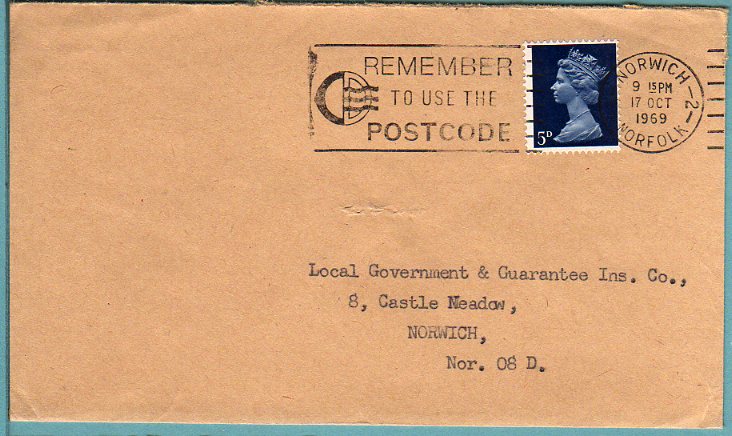
Up to 4 ounces, 1st class 5d (the 5d blue Machin had been issued on 1 July), and 2nd class 4d. The 4d brown Machin was issued on 5 June 1967 but that had two phosphor bands, and so a new 4d brown with a single phosphor band was issued on 16 September, when the new system was introduced.


The regional stamps were issued before the new system started, on 4.9.68. These continued with the existing Wilding designs.

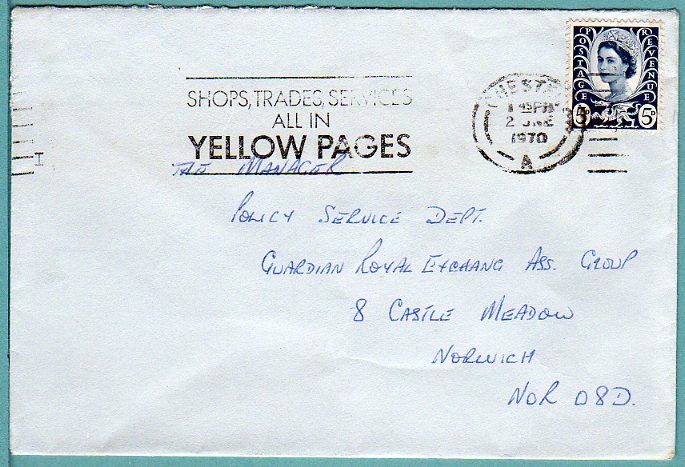
Wales 5d regional
postmarked Chester 2 June 1970. Some north Wales POs were supplied from Chester, and some north Wales mail was taken to Chester for sorting and postmarking.

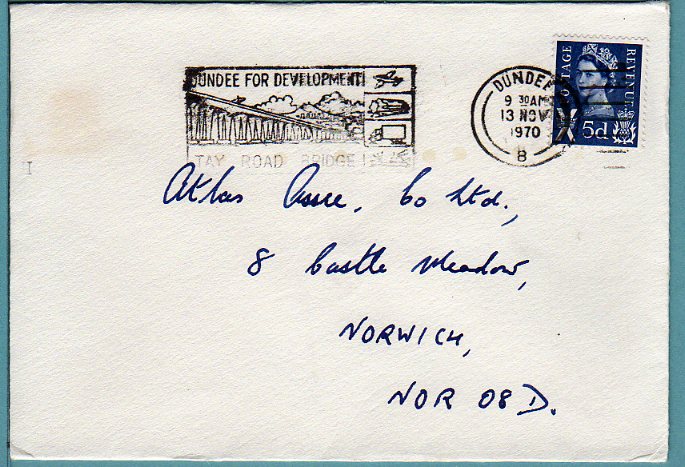
Scotland 5d regional postmark Dundee 13 November 1970

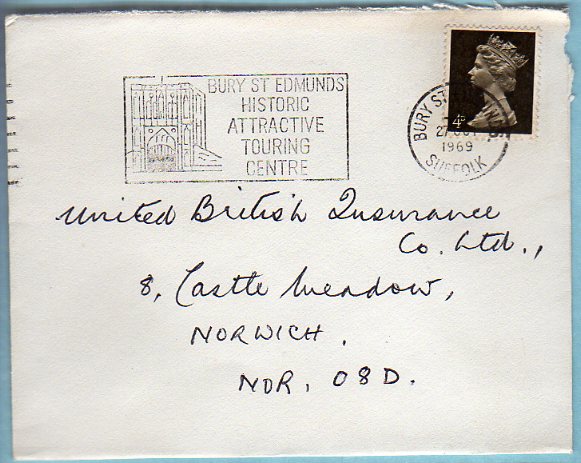
4d brown centre band used 27 September 1969

4d brown (2 phosphor bands) with two ½d Machins to make the 5d rate on day one of the new system: